
Ahead of Prime Minister Nawaz Sharif's visit to United States in October, the United States is negotiating a pact on the new limits on Pakistan's nuclear weapons and delivery systems, a deal which might lead to an agreement that is similar to the Indo-US civil nuclear deal, according to a media report.
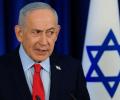
Benjamin Netanyahu declares that the joint Israel-US campaign is successfully 'crushing' Iran, eliminating existential threats and weakening the regime's regional influence.
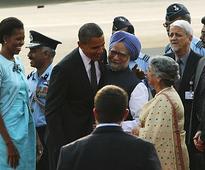
After the second US-India strategic dialogue, Aziz Haniffa finds growing concern about the civilian nuclear deal trapped in limbo.

The intriguing bit is that Trump is likely to attend the talks in Islamabad this weekend -- if he does, it will be the clearest signal yet that the US is ready to exit the war with some sort of win to show, since he cannot afford to go for the talks and return empty-handed, notes Prem Panicker in his must read blog on the Iran War

In the final step to operationalise the India-United States nuclear agreement, American President George W Bush has sent the text of the landmark agreement to the US Congress for final approval.The move by the White House comes five days after the 45-member Nuclear Suppliers Group granted a waiver for India to carry out nuclear commerce.In a statement, the White House said it was transmitting the text of the agreement 'concerning peaceful uses of nuclear energy'.
Elections are still far away and the government has one-and-a-half years to complete, Prime Minister Manmohan Singh said on Friday. The PM said if the India-United States civil nuclear deal does not come through, it will be a disappointment. Dr Singh said the nuclear agreement is an honourable deal that is good for India and good for the world, adding the Government was trying to reconcile the divergent points of view on the issue within the ruling coalition

The Iranian Foreign Ministry has stated that Tehran currently has no plans for a subsequent round of negotiations with the United States, according to the state media Tasnim news agency. This announcement comes as international mediators had hoped for a follow-up to the Islamabad talks before the looming ceasefire deadline.

Trump has made it clear: the US will not lift its blockade of Iranian ports until a deal is signed.

Chaffing under public ridicule in the US as well as internationally for having 'lost' the war, Trump is under immense pressure to do something, cautions Ambassador M K Bhadrakumar.

This sharp Iranian response came after a series of uncompromising remarks from the US president.

Hours after ceasefire, US President Donald Trump on Wednesday warned against any country supplying military weapons to the Islamic Republic, stating that he would impose a 50 percent tariff on all goods exported to the United States.

Iran has announced the Strait of Hormuz is open to commercial vessels, coinciding with a ceasefire between Lebanon and Israel.
Dr Singh would like to resign as prime minister if the Congress party does not back him on the deal. However, negotiations between Dr Singh and the party continue and the final verdict is not out yet.
Before going in for talks, Burns told media persons that the two countries had come a long way in the talks on the agreement since the negotiations began two years ago.
The list of international and national companies in queue to tap the business opportunities arising out of the Indo-US nuclear deal is pretty impressive.
Will US Secretary of State Condoleezza Rice's testimony before the Senate FRC convince the sceptics?

Former US President Donald Trump claimed he stopped a war between India and Pakistan and expressed his desire to be remembered as a great peacemaker.

The deal would allow Japan to export nuclear technology to India, making it the first non-NPT signatory to have such a deal with Tokyo. It would also cement the bilateral economic and security ties as the two countries warm up to counter an assertive China.
'It will take a minor miracle for the deal to beat the clock ticking away in the US Congress, but Abhinav Bindra just proved that the age of miracles isn't over yet.'

As Iran heads into crucial peace talks with the United States of America, here are the six men who decide the Islamic Republic's course.

In his first major national address since hostilities began, Trump said the ongoing military campaign, dubbed 'Operation Epic Fury', has delivered 'swift, decisive, overwhelming victories'.
Stating that India is committed to move forward on the deal, India's new Ambassador to the US Meera Shankar said, "This (deal) is very high on our priority. We are conscious of the fact that it was the US government which did the heavy hitting, if I may use a cricketing metaphor to get this deal through. We would very much like to move forward in a concrete way with agreements for building nuclear reactors with US assistance in India."

Pakistan and China are among the countries which are testing nuclear weapons, United States President Donald Trump has said to justify his administration's plans to resume testing of the US's own nuclear assets after a gap of over three decades.
The key negotiators of the two sides will aim at resolving differences on aspects like reprocessing right and continuity of civil nuclear cooperation if India were to conduct an atomic test in future.

The delegations from the US and Iran head to Islamabad on Friday, carrying a ceasefire that is already fraying, a Strait that is technically open and practically closed, and a negotiating agenda that would challenge even parties actually negotiating in good faith, which these groups are not. Prem Panicker continues his must read blog on the Iran War.
Part of the focus of the current discussions is also on the "next steps" that are involved in the civilian nuclear initiative such as status of India's negotiations with the International Atomic Energy Agency on India-specific safeguards and the NSG
Dr Singh has worked tirelessly for the N-deal. Congratulate him on its passage and debate the historic deal.
The Hyde Act, signed into law by President Bush in December last year, grants the President authority to waive certain sections of the Atomic Energy Act of 1954 and the 1978 Nuclear Nonproliferation Act

But the US will sell F-16 aircraft to Pakistan to fight 'terrorists.'

India has a 'natural global partnership' with US, says PM.
Not subscribing to the view that the Indo-US nuclear deal is dead, Prime Minister Manmohan Singh on Wednesday said he was still hopeful of the deal. "I hope good sense will prevail. I am negotiating in good faith," the Prime Minister said. His remarks came in the midst of government's renewed bid to enlist the support of Left parties for going ahead with securing the India-specific safeguards agreement with the IAEA.
Major powers including Britain and France said the agreement would benefit the non-proliferation regime.

The US Navy seized an Iranian-flagged cargo ship in the Gulf of Oman, escalating tensions as ceasefire talks face uncertainty. The incident raises concerns about the fragile ceasefire and the ongoing blockade of the Strait of Hormuz.

Prime Minister Benjamin Netanyahu stated that Israel and the US struck Iran because Tehran had restarted its nuclear programme and it would have gone 'immune within months'. He claimed Iran was building new underground sites to shield its missile and nuclear programmes from attacks.
Pakistan did not oppose the George W Bush administration's move to ink a civil nuclear agreement with India because it expected it would receive a similar deal from the United States, Prime Minister Yousuf Raza Gilani has said.

Israel will continue its offensive in South Lebanon aimed at neutralising the threat from Hezbollah, which is backed by Iran.

Underwater predators make life hell for everyone from Bollywood's Shanaya Kapoor to Bridgerton's Phoebe Dynevor on OTT this week along with much, MUCH more.
He said during the talks, he explained to the Hungarian Foreign Minister that Pakistan, a declared nuclear state, has a transparent system to ensure strict check on proliferation.

The core issues to be settled -- access to Hormuz, Israel's aggression in Lebanon, the question of Iran's nuclear programme, sanctions relief and compensation -- are thorny enough to require weeks of patient negotiation. The most likely outcome of the opening sessions is that both sides take the measure of each other, establish what is and is not negotiable, and return home without having broken anything. That would count as progress.
